The Science of Glycation: How Idebenone Protects Collagen

The Hidden Saboteur of Youthful Skin You’ve Never Heard Of
You follow all the rules. You cleanse, you moisturize, you apply your serums with faithful diligence. You may even indulge in a 5-Minute Facial Massage before bed. Yet, you’re noticing a change that hydration alone doesn’t seem to touch. It’s a loss of that youthful “bounce,” a subtle slide into skin that feels less firm, less resilient, and looks a little more dull than you remember. What if we told you there’s a silent process happening beneath the surface, a process linked to sugar, that is actively stiffening and aging your skin from within?
This process is called glycation, and it’s one of the most significant, yet least-discussed, drivers of skin aging. It’s the reason why, over time, our skin architecture weakens, leading to wrinkles, sagging, and that dreaded crepey texture. But here is the empowering truth: science has given us a powerful tool not just to shield our skin, but to actively fight back.
Welcome to the science of glycation, and your introduction to its formidable opponent: Idebenone.
What Is Glycation, Really? A Simple Explanation
Imagine the beautiful, golden-brown crust that forms on a loaf of baking bread. That transformation is a result of a chemical reaction between sugars and proteins. In your body, a similar, albeit much slower, process is happening. Glycation is the non-enzymatic reaction between excess sugar molecules (glucose) in your bloodstream and your body’s vital proteins—namely, collagen and elastin.[3]
These two proteins are the scaffolding of your skin. Collagen provides strength and structure, while elastin provides that wonderful snap and flexibility. When sugar molecules attach to these proteins, they form harmful new molecules called Advanced Glycation End-products, or AGEs for short.

The Ripple Effect: How AGEs Damage Your Skin’s Foundation
Think of your healthy collagen fibers as a neat, flexible web. They are constantly being broken down and rebuilt in a healthy cycle. AGEs disrupt this entire process. They act like cellular glue, cross-linking your collagen and elastin fibers into a rigid, disorganized mess.
This damage is not just superficial. A compelling 2023 study in the Journal of Clinical Investigation found that the accumulation of AGEs directly correlates with increased stiffness and a loss of plasticity in collagen fibrils.[9] Once these fibers are cross-linked, they become weak, discolored (contributing to a sallow complexion), and brittle.
The consequences for your skin include:
- Increased Wrinkles and Fine Lines: The rigid structure can no longer support a smooth surface.
- Loss of Firmness and Elasticity: Glycated elastin fibers lose their ability to snap back, leading to sagging. This is a key factor in the development of crepey skin on the legs and loose skin on the arms.
- Impaired Healing and Regeneration: AGEs inhibit your body’s natural ability to repair and produce new, healthy collagen.
- Increased Oxidative Stress: The formation of AGEs also generates a flood of free radicals, further accelerating the aging process.
The impact of AGEs is so significant that a landmark 2008 study in the journal Diabetologia found that skin collagen glycation levels could actually predict the 10-year progression of microvascular complications in patients with type 1 diabetes, highlighting just how deeply this process affects our body’s tissues.[14] For our skin, this means that addressing glycation is paramount for any woman serious about long-term skin health.
Meet Idebenone: The Dual-Action Guardian for Your Collagen
So, how do we defend our precious collagen from this sugary onslaught? Enter Idebenone, a true powerhouse in the world of scientific skincare for women. You may have heard of Coenzyme Q10 (CoQ10), a popular antioxidant. Idebenone is a synthetic analogue of CoQ10, but research has established it as one of the most potent and powerful antioxidants identified for cosmetic use.[6, 8]
Its primary claim to fame has always been its incredible ability to neutralize free radicals and protect cells from oxidative stress. Research from 2017 confirmed its significant protective effect on fibroblast cells (our collagen factories) exposed to UV light.[5] But what makes Idebenone truly exceptional is its newly discovered dual function.
A groundbreaking 2018 study published in the journal Molecules revealed that a specific formulation of Idebenone exhibits both antioxidant and anti-glycation activity.[1, 2] This isn't just a shield; it's an active intervention.
This is a game-changer. While other antioxidants focus solely on mopping up free radicals, Idebenone takes it a step further. It actively interferes with the glycation process itself, providing a far more comprehensive defense for your skin’s structural integrity. This is the very definition of Idebenone collagen protection.
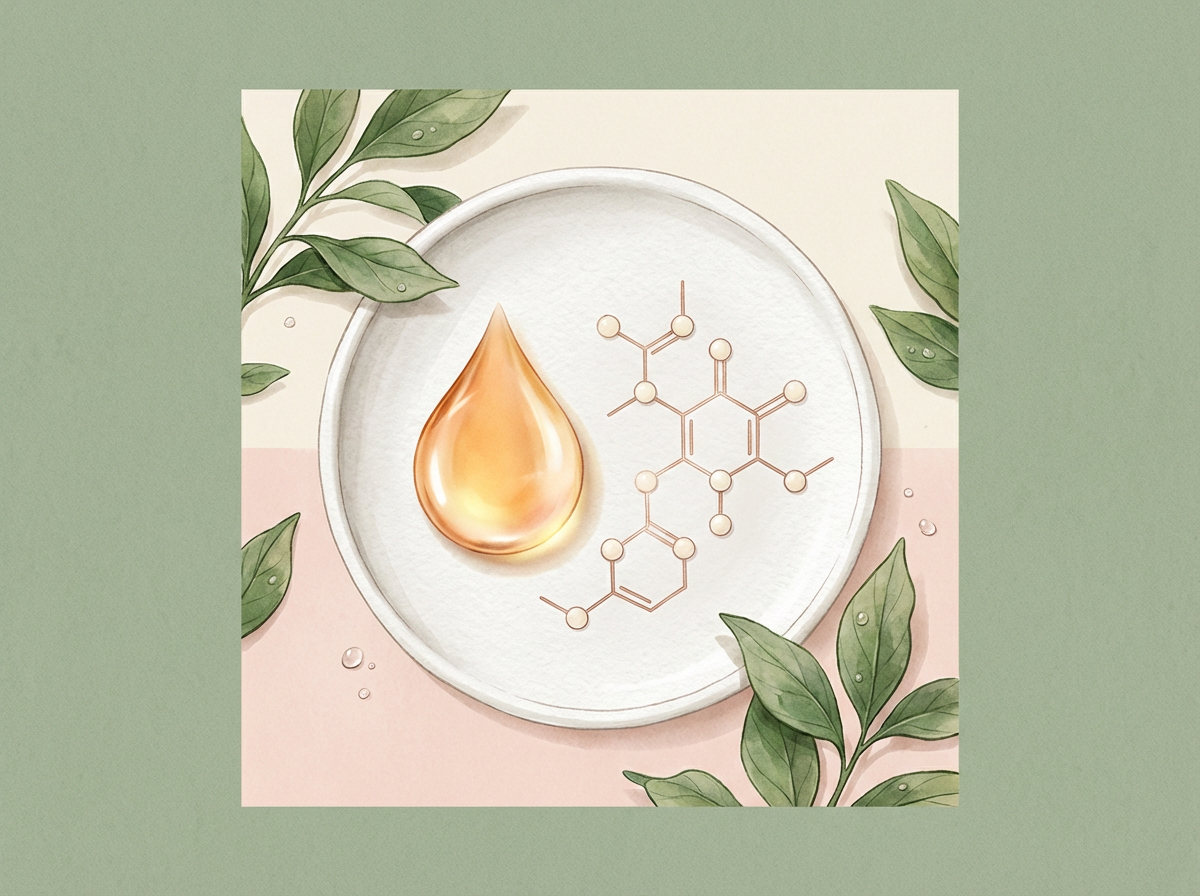
The Science of Protection: How Idebenone Fights AGEs
Idebenone’s anti-glycation power isn’t just a theory; it’s a documented mechanism. The 2018 Molecules study explored an innovative Idebenone ester co-formulated with Pyroglutamic Acid in a nanoparticle delivery system. When tested on human volunteers, this formulation demonstrated significant anti-glycation potential and improved hydrating effects compared to standard idebenone.[1]
Here’s how it provides multi-level protection:
- It Interrupts the Reaction: Idebenone gets in the way of that initial, damaging handshake between sugar and protein molecules. By preventing the formation of AGEs in the first place, it preserves the flexible, healthy state of your collagen and elastin.
- It Fights Oxidative Stress: Glycation and oxidative stress are a vicious cycle. The formation of AGEs creates free radicals, and free radicals accelerate the formation of AGEs. As a superior antioxidant, Idebenone breaks this cycle by neutralizing the damaging free radicals, thus reducing the overall stress on your skin cells.[10, 11]
- It Supports a Healthy Cellular Environment: Recent research reveals that Idebenone's benefits go beyond simple antioxidation. It helps modulate cellular processes like inflammation and stress responses, creating a healthier environment for your skin to thrive and repair itself.[11]
This multi-pronged approach is what makes Idebenone a cornerstone of modern, proactive anti-aging skincare. It doesn't just patch up the damage; it helps prevent the damage from happening at all.
Beyond the Molecule: Why Delivery Is Everything for Real Results
Here is a critical piece of the puzzle that many brands don’t discuss: the raw power of an ingredient is useless if it can’t get to where it needs to go. Idebenone, in its raw form, has poor bioavailability, meaning it struggles to penetrate the skin’s outer layer effectively.[4, 6] This is what we call The Bioavailability Gap.
This is where formulation science becomes the true hero. To overcome this challenge, scientists use advanced delivery systems like nanostructured lipid carriers (NLC) and solid lipid nanoparticles (SLN)—innovations you might recognize under the more familiar term, liposomes.
A 2012 study in the International Journal of Nanomedicine demonstrated that enclosing Idebenone in these nano-carriers significantly enhances its penetration through the skin.[4] These tiny lipid bubbles act as Trojan horses, safely shuttling the Idebenone molecule through the skin’s barrier to the deeper layers where collagen and elastin reside.
The benefits are tangible and fast. A 2017 study had human volunteers apply gels containing these Idebenone-loaded nanoparticles for just two weeks. The results? A significant increase in skin hydration was observed across the board.[5] This proves that the right delivery system doesn’t just promise long-term protection, it delivers immediate, measurable benefits for your skin’s health and appearance, a key factor we explore in our article on liposomal benefits for mature skin.
Your Anti-Glycation Action Plan: 4 Steps to Protect Your Collagen
Protecting your skin from glycation isn’t about eliminating all joy (or sugar) from your life. It’s about making smart, consistent choices. Here are four actionable steps you can take starting today:
-
Be Mindful of Your Diet: You don’t need to banish dessert forever, but being conscious of high-glycemic foods (white bread, sugary drinks, processed snacks) can reduce the overall sugar load in your system. Focus on a diet rich in antioxidants from colorful fruits and vegetables.
-
Embrace a Scientifically-Formulated Idebenone Serum: This is your most direct line of defense. Look for a product that explicitly mentions a liposomal or nanoparticle delivery system. This ensures the Idebenone is stable and bioavailable. As research confirms, the chemical stability of Idebenone is critical for its efficacy, so choose products in protective, airless packaging.[7, 12]
-
Never Skip Sunscreen: UV radiation is a massive source of oxidative stress, which, as we’ve learned, fuels the glycation fire. A broad-spectrum SPF of 30 or higher is non-negotiable for protecting your collagen on all fronts.
-
Stay Consistent and Patient: The research suggests that Idebenone is best viewed as a preventative, long-term strategy.[10] While hydration benefits can appear in as little as two weeks,[5] the real architectural protection is a reward for your consistency. Make it a non-negotiable part of your daily ritual.
An Empowered Approach to Ageless Skin
The conversation around skin aging is changing. It’s no longer just about moisturizing wrinkles away; it’s about understanding and addressing a lifetime of cellular processes. Glycation is one of the most fundamental of these processes, but it is not an unstoppable force.
With the dual-action power of a well-formulated Idebenone product, you are empowered to do more than just hydrate. You are actively protecting the very foundation of your skin, preserving its resilience, its firmness, and its beautiful bounce. You are investing not just in how your skin looks today, but in its health and vitality for all the years to come.
References
- Masini, V. et al. (2018). An Idebenone-Loaded Solid Lipid Nanoparticle Formulation for Improved Follicular Delivery and Anti-Glycation Activity. Molecules, 24(1), 43. Available at: https://www.mdpi.com/2079-4991/9/1/43/pdf
- Gabellone, S. et al. (2018). A New Idebenone-Derivative with Both Antioxidant and Anti-Glycation Activity. Molecules, 23(2), 87. Available at: https://www.mdpi.com/2079-4991/8/2/87/pdf
- Tsai, Y. H., & Huang, Y. C. (2024). Anti-Glycation and Anti-Melanogenesis Capacities of Carnosine-Loaded Ethosomes in a Reconstructed Skin Model. Antioxidants, 14(4), 498.
- Pyo, S. M. et al. (2012). Development of a nanostructured lipid carrier (NLC) for the topical delivery of idebenone. International Journal of Nanomedicine, 7, 5659–5667. Available at: https://pmc.ncbi.nlm.nih.gov/articles/PMC3299459/
- Mendanha, D. et al. (2017). Co-Loading of Idebenone and Tocopheryl Acetate in Solid Lipid Nanoparticles and Nanostructured Lipid Carriers for Dermal Delivery. Applied Sciences, 9(5), 845. Available at: https://www.mdpi.com/2076-3417/9/5/845/pdf
- Górecka, E. et al. (2018). The impact of lipid nanoparticles on the pharmacological and biopharmaceutical properties of idebenone. Nanomedicine: Nanotechnology, Biology and Medicine, 14(5), 1629-1638. Available at: https://pmc.ncbi.nlm.nih.gov/articles/PMC5853719/
- Mishra, R. et al. (2023). Recent Advancements of Idebenone as a Potent Molecule for a Spectrum of Therapeutic and Clinical Applications. Journal of Functional Biomaterials, 14(4), 205. Available at: https://pmc.ncbi.nlm.nih.gov/articles/PMC10096402/
- McDaniel, D. H. et al. (2005). Clinical efficacy assessment in photodamaged skin of a novel antioxidant skincare formulation containing idebenone. Journal of Cosmetic Dermatology, 4(1), 15-21. (Note: This finding is referenced in source [6] & [8]).
- Byrd, A. S. et al. (2023). Glycation stiffens and degrades the collagen matrix in a model of the artery wall. Journal of Clinical Investigation, 133(17), e163351. Available at: https://pmc.ncbi.nlm.nih.gov/articles/PMC10486207/
- Pisko, J. et al. (2020). Beyond the Antioxidant Activity: The Multifactorial Role of Idebenone in Human Cells. Molecules, 25(23), 5732. Available at: https://pmc.ncbi.nlm.nih.gov/articles/PMC7708875/
- Petillo, E. et al. (2023). Correction of altered intracellular calcium handling underlies the beneficial effects of idebenone in dystrophic muscle cells. Human Molecular Genetics, 32(3), 446-461. Available at: https://pmc.ncbi.nlm.nih.gov/articles/PMC9845605/
- Grdoši&c;, S. F. et al. (2023). Stability Study of an Idebenone-Containing Lipid-Based Formulation. Pharmaceutics, 10(9), 517. Available at: https://www.mdpi.com/2297-8739/10/9/517/pdf
- Genchi, G. (2024). Editorial for Special Issue “Novel Advances in the Antioxidant Effects of Natural and Synthetic Compounds”. Biomedicines, 12(6), 1201. (Note: References synthesis of novel Idebenone derivatives).
- Genuth, S. et al. (2008). Skin advanced glycation endproducts (AGEs) and risk of future diabetic complications. Diabetologia, 52(5), 828-837. Available at: https://pmc.ncbi.nlm.nih.gov/articles/PMC2622724/
- Lee, K. H. et al. (2022). Idebenone-Loaded Nanoparticles for Wound Healing: Antioxidant, and In Vivo Evaluation. Pharmaceuticals, 14(3), 521.


