Sun Damage vs. Crepey Skin: Repair Your Decolletage

If you’ve ever caught a glimpse of your neck and chest in bright bathroom lighting and thought, “My face care is paying off… but my décolletage is telling a different story,” you are not alone. After 50, many women notice sun damaged skin and crepey skin on the neck and chest long before the rest of their skincare routine shows its age.
The good news: while we cannot erase every hour of sunbathing from our twenties, there is a lot you can do right now to soften lines, fade sun spots, and start real décolletage repair—without waging war on your skin.
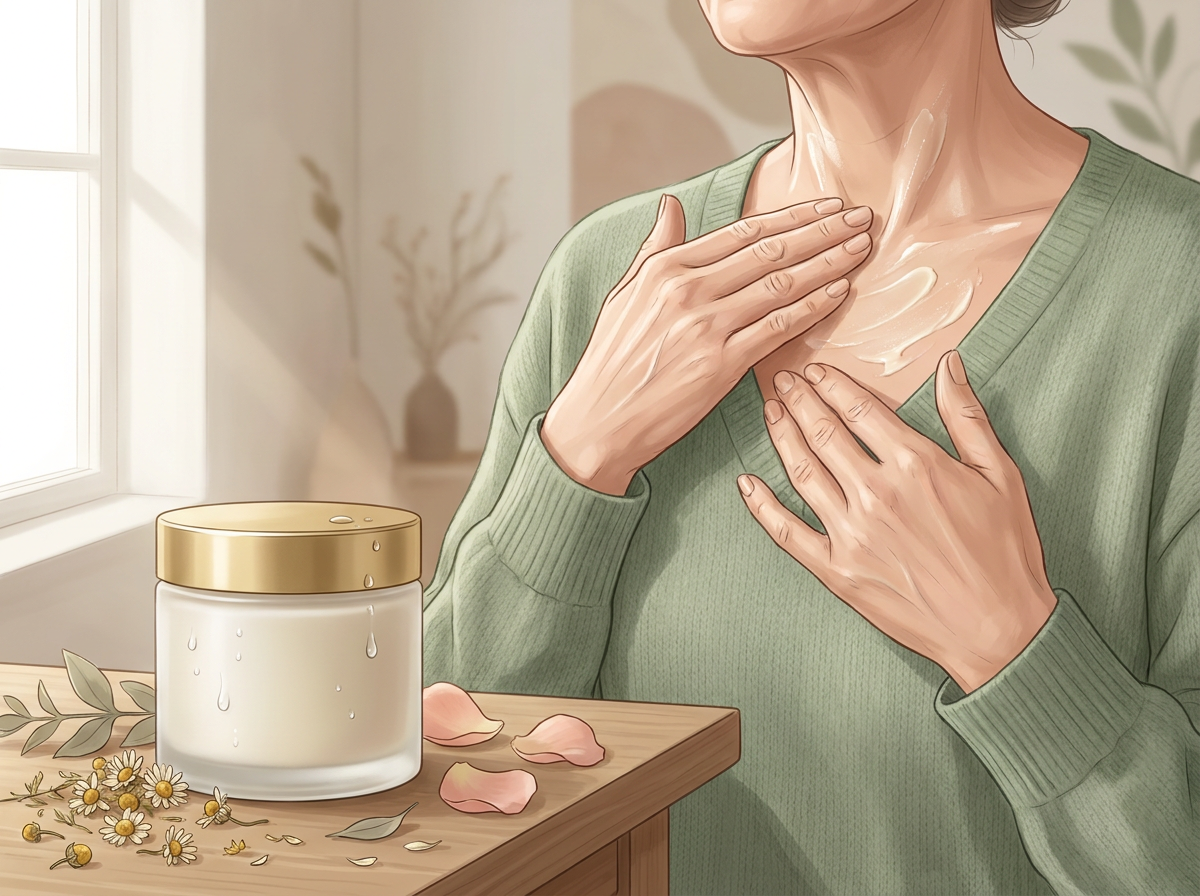
Sun Damage vs. Crepey Skin: What’s Really Happening?
The neck and chest have a unique challenge: the skin here is thinner, has fewer oil glands, and is often left out of daily skincare and sunscreen. Over decades, that combination adds up.
What is sun damaged skin over 50?
Dermatologists often use the term photoaging to describe how ultraviolet (UV) light accelerates aging in exposed skin areas like the face, neck, and chest.[13] Over time, repetitive exposure—especially intense bursts like vacations or tanning—can cause:
- Brown spots and uneven pigmentation
- Redness and visible blood vessels
- Thickened or rough texture
- Fine lines and deeper wrinkles
- Dry, dull-looking skin that doesn’t “bounce back”
On the décolletage, repeated sun exposure breaks down collagen and elastin, the two key proteins that keep skin firm and smooth.[1][13] As these fibers weaken, the surface looks more wrinkled and irregular.
What is crepey skin on neck and chest?
Crepey skin is that thin, finely wrinkled, almost tissue-paper texture you might see when you lean forward or when the skin is at rest. It can result from:
- Collagen and elastin loss from aging and sun
- Chronic dryness and a weakened skin barrier
- Thinning of the epidermis (the outer layer of skin)
Sun is a major driver here as well—UV damage accelerates the breakdown of collagen and elastin and contributes to that crinkled look.[1][14]
Think of it this way: Sun damage is the long-term “history” written into your skin (spots, redness, roughness). Crepey skin is how that history shows up in the texture—especially when collagen, elastin, and hydration are depleted.
That’s why you may see both issues at once: mottled color from sun exposure and delicate, crinkly texture across the chest.
Step 1: Protect What You Have (So Repair Can Actually Work)
Every effective decolletage repair plan starts with protection. Without it, even the best firming neck cream or serum is fighting an uphill battle.
Sunscreen: non‑negotiable for neck and chest
Experts are remarkably consistent: daily broad-spectrum sunscreen on the neck and décolletage is essential to prevent further damage and protect any progress you make.[1][2][4][7][11][13]
- Choose a broad-spectrum SPF 30–50 (protects against UVA and UVB).
- Apply to neck, chest, and shoulders if they’re exposed—not just the face.
- Reapply every 2 hours when outdoors, or after sweating or swimming.[1][11][13]
The Cleveland Clinic emphasizes that applying sunscreen daily to all uncovered skin is a cornerstone of managing sun-damaged skin.[13]
Smart sun habits that make a visible difference
Beyond SPF, small daily habits protect collagen and support your skin’s repair process:
- Time your sun: Limit direct exposure between 10 a.m. and 4 p.m. when rays are strongest.[1][11][13]
- Use clothing as skincare: Light scarves, higher necklines, and UPF clothing add a physical barrier.[1][11][13]
- Avoid purposeful tanning: Both outdoor tanning and tanning beds accelerate photoaging and increase skin cancer risk.[13]
This protective foundation does two important things: it prevents new UV injury and gives your neck and chest the stability they need to respond to hydrating and firming products.
Step 2: Build a Gentle, Targeted Décolletage Routine
Once protection is in place, it’s time to support the skin’s natural repair processes and address both sun damage and crepey texture. Unlike the tougher skin on your body, the neck and chest behave more like your face—just a little more delicate.
Cleanse with care
A stripped, tight-feeling chest will always look more crepey. Dermatology practices recommend washing the area with lukewarm water and a gentle, non-stripping cleanser.[3][11]
- Avoid very hot water, which can dehydrate and irritate.
- Skip harsh scrubs; the skin here is already thin.
Hydration: the fastest visible win for crepey skin
Dehydrated skin exaggerates every fine line. Using a hydrating serum or moisturizer with hyaluronic acid can visibly plump crepey skin by drawing water into the skin and supporting a smoother surface.[1][3][6][7][11]
- Look for ingredients like hyaluronic acid, glycerin, and ceramides.
- Apply to slightly damp skin on neck and chest to lock in moisture.
Several experts recommend using your hydrating face serums and moisturizers down to the chest, not stopping at the jawline.[1][7][11]
Antioxidants to help fade spots and shield from future damage
For sun damaged skin over 50, antioxidant serums are powerful allies. Vitamin C, in particular, can brighten uneven pigment and support collagen, while neutralizing free radicals from UV and pollution.[1][6][7][8][11]
- Use a vitamin C serum or antioxidant blend in the morning, after cleansing and before sunscreen.
- Antioxidants help with discoloration and support firmer-looking skin over time.
Cosmetic doctors often recommend vitamin C specifically on the décolletage to help even out pigmentation from sun damage.[6][8]
Introduce retinoids slowly for texture and firmness
Retinoids (retinol or prescription tretinoin) are considered a gold standard for improving fine lines, rough texture, and signs of photoaging.[3][8][11][13][14] They encourage skin cell turnover and support new collagen formation.
Because the neck and chest are more sensitive:
- Start with a low-strength retinol 2–3 nights a week, not every night.[3][8][11][14]
- Apply a pea-sized amount to the whole neck and chest, not just spots.
- Follow with a soothing, hydrating cream to reduce irritation.[8][11]
Dermatologists stress that retinoids on the chest should be used carefully and paired with rich moisturizers to avoid over-drying.[8][14]
Where does a firming neck cream fit in?
A firming neck cream is not magic, but it can be a helpful part of your routine, especially if it’s well-formulated. High-quality neck and décolletage creams often combine:
- Peptides to support skin firmness
- Hyaluronic acid or other hydrators for plumping
- Barrier-supporting lipids, like ceramides
Some dermatologist-recommended neck creams also include growth factors or gentle retinoids to support rejuvenation in sun damaged, crepey skin.[8][11]
Tip: Whatever firming neck cream you choose, commit to using it consistently, morning and night, for at least 8–12 weeks. Skin changes at 50+ are real and meaningful, but they are gradual.
Step 3: At-Home Rituals to Support Decolletage Repair
Little changes in how you treat this area—both day and night—can support the science-backed products you’re using.
Thoughtful exfoliation (the gentle kind)
Light exfoliation can help with roughness and dullness from sun damage, allowing serums and creams to penetrate more effectively.[1] But this is not the place for aggressive scrubs.
- Use a mild chemical exfoliant (like lactic acid) once or twice a week at most.
- Avoid using multiple active products (retinoid + strong acids) on the same night.
Over-exfoliation can worsen redness and fragility, especially on already sun damaged skin.
Nighttime: when your décolletage does its best repair work
Dermatology clinics highlight nighttime as a prime opportunity for neck and décolletage restoration.[11] Consider this simple evening pattern:
- Double cleanse to remove sunscreen, sweat, and pollution.[11]
- Apply a retinol or retinoid 2–3 nights weekly (skip on irritated days).[3][8][11][14]
- Layer a hydrating serum with hyaluronic acid.
- Finish with a nourishing neck and chest cream.
Let products fully absorb before lying down to prevent transfer to your pillowcase and to maximize contact time with the skin.
Position and support matter
While not strictly about sun or crepey skin, mechanical lines can deepen creases over time:
- Sleeping on your back can reduce those vertical chest lines formed when side-sleeping.
- A well-fitting, supportive bra (day and night, if comfortable) can minimize skin folding, especially if you have a fuller chest.[15]

Step 4: When to Consider In-Office Treatments
Home care is incredibly important, but for more advanced sun damage or pronounced crepey skin on the neck and chest, dermatologists often recommend pairing a good routine with professional treatments.
Lasers and light therapies
For marked discoloration, sun spots, and rough texture, laser and light therapies can be very effective:
- Fractional lasers (like Fraxel or CO2 lasers) target columns of skin to stimulate collagen and improve crepey texture and wrinkles.[3][5][8][12]
- Intense pulsed light (IPL) can reduce redness and brown spots, especially in conditions like poikiloderma on the chest.[3][8][12][15]
- Photodynamic therapy (PDT) may be used for sun-damaged chests with precancerous changes such as actinic keratoses.[12]
Clinics note that lasers can both remove sun-damaged cells and encourage new collagen growth, significantly improving texture and color.[3][5][8][12]
Microneedling and injectable options
For crepey texture and loss of firmness, some practitioners use:
- Microneedling to stimulate collagen and elastin in thin, delicate chest skin.[10]
- Hyperdilute calcium hydroxylapatite fillers (like diluted Radiesse) to gently thicken and firm crepey décolletage skin.[3]
These treatments are usually done in a series and are often combined with home care (retinoids, antioxidants, SPF) for best results.[3]
Important: Any in-office treatment on the chest requires strict sun avoidance before and after, plus diligent sunscreen use, to protect the healing skin and lock in your results.[3][5][8][12]
Putting It All Together: A Simple Daily Plan for Your Décolletage
If you’re thinking, “This sounds like a lot,” remember you can build this gradually. Here is a realistic routine that supports both sun damaged skin over 50 and crepey skin on neck and chest—without overwhelming your schedule.
Morning routine
- Cleanse neck and chest with a gentle, non-stripping cleanser and lukewarm water.[3][11]
- Apply an antioxidant serum (vitamin C or a blend) from face down to chest.[1][6][7][8][11]
- Layer a hydrating serum or light moisturizer with hyaluronic acid for plumping.[1][3][6][7][11]
- Apply a dedicated firming neck cream if you use one.
- Finish with broad-spectrum SPF 30–50, covering all exposed neck and chest.[1][2][4][7][11][13]
Evening routine
- Double cleanse to remove sunscreen and impurities.[11]
- Use a gentle retinol 2–3 nights per week on neck and chest (none on irritated nights).[3][8][11][14]
- On non-retinoid nights, you can use a mild exfoliant or focus on hydration only.[1]
- Apply a hydrating serum followed by a rich moisturizer or neck cream.
Once your routine feels comfortable, you can explore in-office options with a board-certified dermatologist if you want more dramatic improvement in discoloration, lines, or sagging.
How this fits with your other Hygieia rituals
If you’ve already explored deeply hydrating your skin (Deeply Hydrate Skin Over 50: 4 Science-Backed Ways) or firming the neck and chest with body tools (Smooth Crepey Neck & Chest Skin After 50 with Body Tools), this approach layers beautifully with what you’re doing. Think of this article as your next step in addressing the specific story that the sun has written into your décolletage.
CTA: Your Next Best Step for a Softer, Smoother Décolletage
You do not have to accept that your neck and chest will always look “older” than your face. Even if you see pronounced crepey skin on neck and chest, or years of sun damaged skin over 50, your skin is still responsive and capable of repair.
If you’re ready to start today:
- Commit to broad-spectrum SPF on your neck and chest every morning—no exceptions.
- Choose one targeted step (a hydrating serum, an antioxidant, or a gentle retinol) and use it consistently for 8–12 weeks.
- When you’re comfortable, talk with a dermatologist about whether laser, microneedling, or light treatments could help with deeper lines and sun spots.
At Hygieia, our philosophy is simple: pair science-backed ingredients with daily rituals that feel like care, not punishment. Your décolletage has carried decades of sunshine, laughter, and life with you. With a thoughtful routine, a trusted firming neck cream, and committed sun protection, you can help it look as vibrant and confident as you feel inside.


