Wrinkles vs. Crepey Skin: Do You Know the Difference?

Is It a Wrinkle, or Is It Crepey? The Question on Every Woman’s Mind
You see it in the right light—or, perhaps, the wrong one. You’re applying your favorite body lotion or catching your reflection as you reach for something on a high shelf, and you notice a change in your skin’s texture. It’s not just a simple fold or a laugh line you’ve come to know. It’s finer, thinner, more like a delicate piece of crumpled tissue paper. You wonder, “Is this a wrinkle, or is it something else?”
For so many of us navigating our skin’s journey after 50, this is a familiar moment of uncertainty. We’ve spent decades learning about wrinkles, but suddenly, the vocabulary of our skin seems to be expanding. The term “crepey skin” enters the conversation, often used interchangeably with wrinkles, yet describing a fundamentally different experience. Understanding this distinction isn’t just about semantics; it’s the key to choosing the right care, honoring your skin’s evolving needs, and feeling truly empowered in your self-care rituals.
The truth is, crepey skin and wrinkles are not the same. They arise from different structural changes deep within your skin and, therefore, respond to different types of care. Let’s demystify the science behind your skin’s texture, so you can move forward with clarity and confidence.
The Anatomy of a Wrinkle: More Than Just a Line
Wrinkles are the lines and creases we have long associated with aging. They are typically most prominent on areas of the face and body that experience repeated movement—think of the crow’s feet from smiling, the frown lines between our brows, or the folds around our mouth. But what’s happening beneath the surface?
A wrinkle is primarily a story of lost elasticity. Imagine a brand-new rubber band. You can stretch it, and it snaps right back to its original shape. Now, picture an old rubber band that’s been left out in the sun. It becomes brittle and, when stretched, either breaks or only partially returns to its form. Your skin’s elastin fibers behave in a similar way.
Scientifically, this is known as a decline in biomechanical function. A 2019 study in the Journal of the Mechanical Behavior of Biomedical Materials highlighted that intrinsic skin aging causes a significant loss of elasticity (P < 0.001) [10]. This means the skin’s ability to "snap back" after being stretched or compressed is profoundly reduced. When this happens, the repeated muscular contractions from facial expressions or body movements eventually etch permanent folds into the skin. The structural support system can no longer smooth itself out.
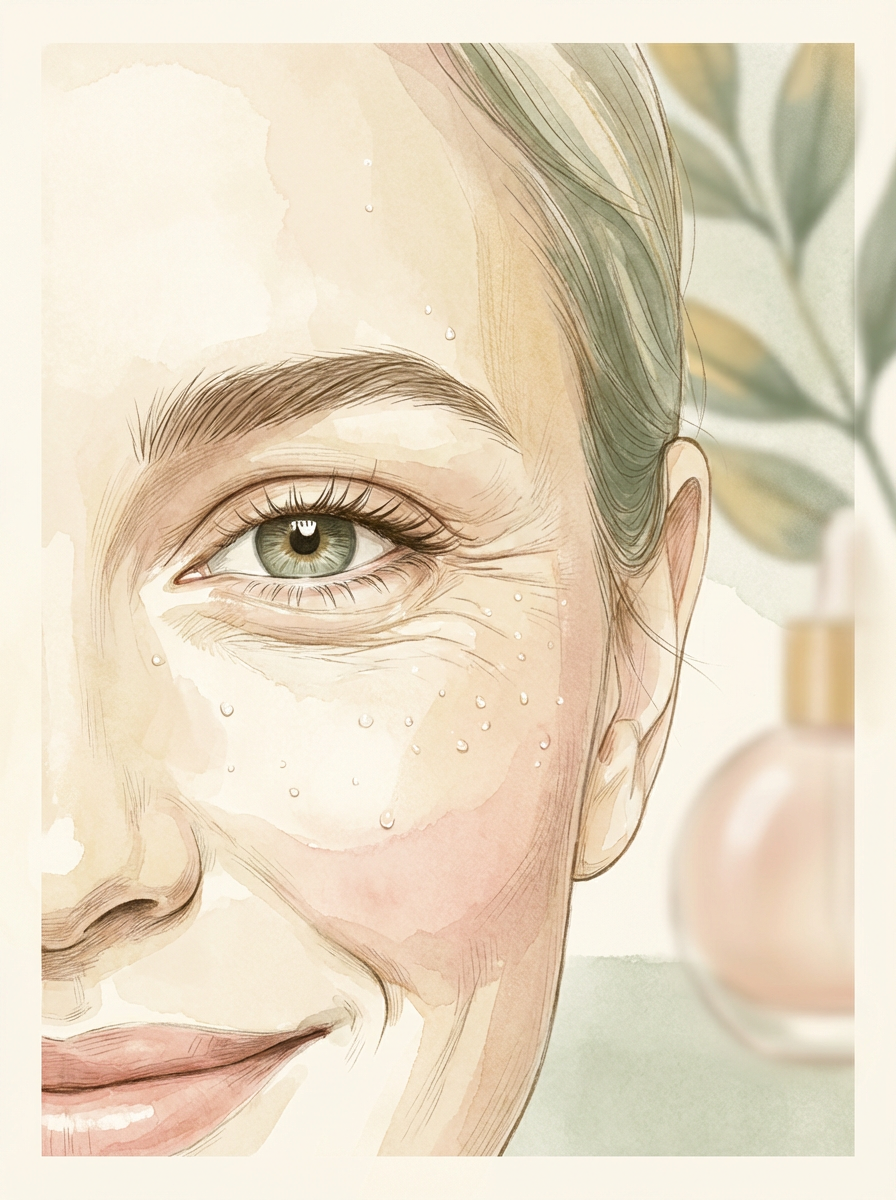
These changes are not just on the surface. Research from a 2022 study in Skin Research and Technology performed a layer-by-layer mechanical analysis of facial skin. The findings were clear: there is a significant, age-dependent decrease in the stiffness and integrity of the deeper dermal layers [1]. So, a wrinkle isn’t just a surface crease; it’s a symptom of a deep structural collapse in the skin’s supportive framework.
In short: Wrinkles are distinct folds or creases formed primarily due to a loss of elasticity—the skin’s ability to bounce back—which is why they appear in areas of frequent movement.
Decoding Crepey Skin: The Telltale Thinness
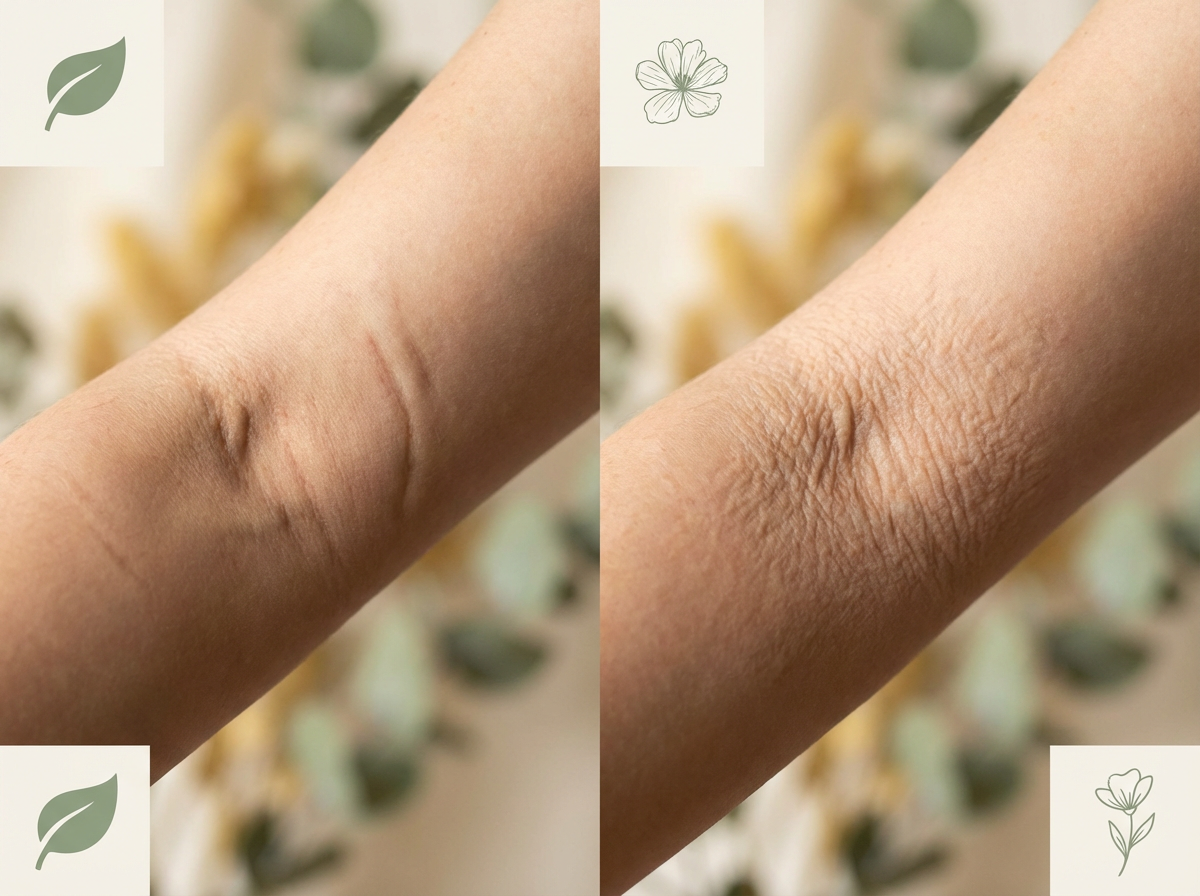
Now, let’s turn to crepey skin. While it often appears alongside wrinkles, it is a different phenomenon. Crepey skin is characterized by its thin, finely crinkled, and fragile texture, much like crêpe paper. It’s most common on areas where the skin is already naturally thin and fragile, such as the under-eyes, the neck, the inner arms, and the skin above the knees.
If wrinkles are about a loss of elasticity, crepey skin is about a loss of resilience and thickness. Think of the difference between a sheet of sturdy cardstock and a piece of tissue paper. The cardstock is thick and resilient; you can bend it, and it holds its shape. The tissue paper is delicate and will crinkle at the slightest pressure. Crepey skin is the result of your skin becoming more like that tissue paper.
The same 2019 study that documented the loss of elasticity also found that aging skin suffers from a significant loss of resilience (P < 0.01) [10]. Resilience is the skin’s ability to resist thinning and textural changes. This process involves the effacement, or thinning out, of dermal structures. The supportive collagen and fat matrix beneath the skin depletes, and the epidermis (the outermost layer) becomes thinner. Without this underlying cushion and support, the skin loses its smooth, plump texture and begins to appear finely crinkled and loose.
This is why you can have crepey skin on an area with very few expression lines, like your upper arms. It’s not about muscle movement; it’s about the very substance and structure of the skin itself becoming fragile. This is also why aggressive stretching or pulling of the skin can make its appearance more pronounced.
In short: Crepey skin is a finely wrinkled, thin texture caused by a loss of resilience and dermal thickness. It’s a sign of the skin’s underlying support structure becoming more fragile.
The Root Causes: Why Our Skin Changes After 50
Understanding what wrinkles and crepey skin are is the first step. The next is understanding *why* they happen, especially with the accelerated pace we often notice after menopause. The changes in mature skin texture are driven by a combination of internal and external factors.
1. The Unavoidable Duo: Intrinsic and Extrinsic Aging
Skincare science divides the aging process into two categories:
Intrinsic Aging: This is the natural, genetically predetermined aging process. It’s the unavoidable timeline of our cellular biology. Research has shown that intrinsic aging is caused by the slow buildup of damaging byproducts from our own cellular metabolism, which impairs biological functions over time [5, 11]. It’s a key reason why our skin’s ability to produce robust collagen and elastin declines with every passing year. Genetic factors also play a huge role, influencing your personal pattern of skin aging based on your ethnicity and family history [9].
Extrinsic Aging: This refers to aging caused by external, environmental factors. The single greatest contributor to extrinsic aging is chronic sun exposure (photoaging) [10, 11]. UV radiation generates free radicals that aggressively break down collagen and elastin, accelerating fragility, thinning, and wrinkling. A 2008 study in the Journal of Dermatological Science confirmed that age and cumulative solar exposure are the most powerful forces promoting skin aging [6].
For women over 50, we are living with the cumulative effects of both. The wisdom and experiences of our decades also mean decades of sun exposure and our natural, intrinsic clock ticking forward. This dual impact is what makes targeted skincare so crucial in this chapter of life.
2. The Menopause Factor: A Hormonal Shift
We cannot talk about skin changes in women over 50 without discussing menopause. The decline in estrogen has a profound and direct impact on skin health. Estrogen plays a vital role in maintaining skin thickness, hydration, and collagen production.
When estrogen levels drop, these processes are disrupted. A 2012 study on recently menopausal women confirmed what many of us have felt intuitively: the hormonal shift leads to measurable changes in skin wrinkling and rigidity [12]. Rigidity, in this context, is closely related to the loss of resilience that leads to crepey texture.
Fascinatingly, a 2014 study published in Skin Research and Technology found that postmenopausal women exhibit asymmetric changes in facial skin viscoelasticity [4]. This means that the skin on different parts of the face can lose its firmness and elasticity at different rates, explaining why you might see more pronounced crepey texture under your eyes but deeper wrinkles on your forehead. Your skin doesn’t just age; it ages uniquely across its own landscape, driven by these hormonal fluctuations.
Beyond the Mirror: How Science Objectively Measures Mature Skin Texture
One of the most validating developments in modern dermatology is the ability to objectively measure skin aging. It’s no longer just about what we see in the mirror. Scientists and dermatologists now use sophisticated tools to quantify changes in skin texture, providing a concrete way to prove that the interventions we use are actually working.
Clinical assessments of skin aging now routinely include biophysical measurements of roughness, color, skin elasticity, and barrier function [2, 3]. For example, a 2024 study in the Journal of Cosmetic Dermatology involving over 300 women established clear reference ranges that correlate skin firmness parameters with age, giving us a baseline for what is happening at a structural level [14].
Furthermore, advanced techniques are changing how we track progress. As one 2023 study in Skin Research and Technology describes, advanced image processing with dermatoscope devices can now detect and quantify both wrinkles and overall skin roughness with incredible accuracy [7]. This is vital for evaluating the true efficacy of new skincare products.
Why does this matter to you? Because it confirms that what you are experiencing is real, measurable, and biological. It validates the importance of your skincare efforts and helps us understand that addressing these changes is about restoring health and function to the skin, not just chasing an aesthetic.
As one 2023 review in the International Journal of Molecular Sciences powerfully states, the changes leading to wrinkles and crepey skin result in "impaired biological functions beyond cosmetic concerns" [8]. Taking care of your skin is a true act of health and wellness.
Your Action Plan: A Targeted Approach for Wrinkles and Crepey Skin
Now for the most important part: what can we do? Since wrinkles and crepey skin stem from different primary issues—elasticity loss vs. thinning/resilience loss—the most effective routine will address both with specific strategies.
Strategy 1: To Address Wrinkles (Targeting Elasticity)
To fight the folds and lines caused by elasticity loss, your focus should be on stimulating collagen and protecting the elastin you still have.
Invest in Collagen-Supporting Ingredients: Look for powerhouse ingredients like peptides and Vitamin C, which are known to signal to your skin to produce more of its structural proteins.
Protect Relentlessly from the Sun: Since UV exposure is a primary driver of elastin degradation, a broad-spectrum SPF of 30 or higher is the single most effective anti-wrinkle product you can use. Every single day.
Prevent Further Degradation: Collagen breakdown isn’t just from the sun; it’s also caused by internal processes like glycation. To learn more about how sugar molecules can stiffen and degrade your collagen, we highly recommend reading our post, "The Science of Glycation: How Idebenone Protects Collagen." Understanding this process is a game-changer for preserving skin firmness.
Strategy 2: To Address Crepey Skin (Targeting Thinning and Resilience)
To combat the thin, crinkled texture of crepey skin, the goal is to hydrate intensely, support the skin barrier, and deliver powerful actives deep into the dermis to help restore its density and resilience.
Hydrate Inside and Out: Crepey skin is often dehydrated skin. Use products rich in humectants like hyaluronic acid and glycerin, which draw moisture into the skin, and seal it in with emollients and occlusives like shea butter, squalane, and ceramides to fortify your skin’s protective barrier.
Exfoliate Gently: Promoting cell turnover can help improve the surface texture of crepey skin. However, because the skin is fragile, it’s crucial to be gentle. A method like dry brushing can be wonderful for the body. For a step-by-step guide, see our tutorial: "Dry Brushing for Crepey Skin: A Tutorial for Women Over 55."
Deliver Actives Where They Matter Most: This is where ingredient technology becomes paramount. The structural thinning that causes crepey skin happens deep in the dermis. Therefore, you need active ingredients that can actually reach that destination. This is why we at Hygieia champion liposomal technology. A liposome is a tiny, protective bubble that encapsulates a powerful active ingredient—like the super-antioxidant Idebenone—and delivers it past the skin’s surface to the deeper layers where it can do its work. For a deeper dive into this technology, don’t miss our article, "The Bioavailability Gap: Liposomal Idebenone Explained." A powerful antioxidant like Idebenone helps protect the fragile dermal matrix from the oxidative stress that contributes to thinning.
The Unifying Solution: A Holistic Approach
While the strategies are distinct, many of the best ingredients and practices serve both goals. A well-formulated product with Liposomal Idebenone, for instance, provides the antioxidant protection needed to preserve elasticity (helping with wrinkles) while also supporting the dermal matrix to build resilience (helping with crepey skin). You don’t necessarily need dozens of different products, but rather a few intelligent, multi-tasking formulas designed with the science of mature skin in mind.
Our body treatments are specifically formulated to address these intertwined concerns. To see how these principles apply directly to common problem areas, explore our targeted guides:
The Hygieia Philosophy: Skincare as Self-Knowledge
At Hygieia, we believe that the most powerful skincare routine begins with knowledge. Understanding the difference between a wrinkle and a patch of crepey skin transforms your relationship with your body. It moves you from a place of frustration or confusion to a position of empowered, intentional action. You are no longer just trying products; you are implementing a targeted strategy based on the specific biological needs of your skin.
Our formulations are born from this very principle. We look at the latest scientific research—like the studies showing how advanced tissue-engineered skin models can validate the efficacy of anti-aging actives [15]—and use it to create products that deliver real, measurable results. By pairing potent natural ingredients with sophisticated delivery systems like liposomes, we ensure that our formulas honor the complexity and elegance of mature skin.
Your skin tells the story of your life. The goal is not to erase that story, but to ensure it is told on a canvas that is healthy, resilient, and radiant. Recognizing the nuances of your skin’s texture is the first, most beautiful step in that journey.
Ready to Transform Your Routine?
Now that you can distinguish between wrinkles and crepey texture, you’re ready to give your skin the precise care it needs. Explore our curated collection of Liposomal Idebenone treatments, designed to restore resilience, firmness, and radiance to mature skin.
References
Langton, A. K., et al. (2022). Layer-by-layer mechanical analysis of human facial skin reveals age-dependent changes in the properties of the dermis. Skin Research and Technology. Available at: https://pmc.ncbi.nlm.nih.gov/articles/PMC8764052/
Kim, E., et al. (2015). Clinical and Biophysical Characteristics of Korean Women’s Skin. BioMed Research International. Available at: http://downloads.hindawi.com/journals/bmri/2015/318586.pdf
Lee, Y. B., et al. (2015). Hot-Water-Extracted Purple Corn Hull Antioxidant for Anti-Aging in Human Skin. Journal of the Korean Society for Applied Biological Chemistry. Available at: https://pmc.ncbi.nlm.nih.gov/articles/PMC4341846/
Le-Floc’h, A., et al. (2014). Asymmetric facial skin viscoelasticity in postmenopausal women. Skin Research and Technology. Available at: https://pmc.ncbi.nlm.nih.gov/articles/PMC3990288/
Kohl, E., et al. (2020). Skin ageing. Journal of the European Academy of Dermatology and Venereology. Available at: https://pmc.ncbi.nlm.nih.gov/articles/PMC7481755/
Tsukahara, K., et al. (2008). The effect of environmental factors on the prevalence of facial wrinkles in Japanese women. Journal of Dermatological Science. Available at: https://pmc.ncbi.nlm.nih.gov/articles/PMC2613964/
Hames, S. C., et al. (2023). A unified approach to the detection and analysis of wrinkles and skin roughness using image processing. Skin Research and Technology. Available at: https://onlinelibrary.wiley.com/doi/10.1111/srt.13335
Milan, A., et al. (2023). Skin Aging: A Review of the Pathophysiology and Therapeutic Options. International Journal of Molecular Sciences. Available at: https://pmc.ncbi.nlm.nih.gov/articles/PMC10316705/
Farage, M. A., et al. (2013). Structural characteristics of the aging skin: a review. Cutaneous and Ocular Toxicology. Available at: https://pmc.ncbi.nlm.nih.gov/articles/PMC3583889/
Ge, Y., et al. (2019). The biomechanical and histomorphological changes of the intrinsic aging of skin. Journal of the Mechanical Behavior of Biomedical Materials. Available at: https://pmc.ncbi.nlm.nih.gov/articles/PMC6851988/
Zhang, S., & Duan, E. (2018). Fighting against Skin Aging: The Way from Bench to Bedside. Cell Transplantation. Available at: https://pmc.ncbi.nlm.nih.gov/articles/PMC3840548/
Le-Floc’h, A., et al. (2012). Skin wrinkling and rigidity in recently menopausal women: a prospective, longitudinal, observational study. The British Journal of Dermatology. Available at: https://pmc.ncbi.nlm.nih.gov/articles/PMC3026089/
Takahashi, A., et al. (2024). Age-related changes in skin condition in a large Japanese population. Journal of Cosmetic and Laser Therapy. Available at: https://www.frontierspartnerships.org/articles/10.3389/jcia.2024.13561/full
Gröner, S. U., et al. (2024). Generation of reference ranges for skin firmness parameters in German women aged 20–69 years. Journal of Cosmetic Dermatology. Available at: https://onlinelibrary.wiley.com/doi/10.1111/jocd.16773
Berenguer, D., et al. (2022). Bioengineered Human Skin Models to Study Skin Aging. Applied Sciences. Available at: https://pmc.ncbi.nlm.nih.gov/articles/PMC8844123/
'''


